


Grand Canyon Backpacking Guide | Hike Tee
Dominic PalmowskiGrand Canyon backpacking looks simple from the rim until you remember the trail only goes one easy direction. Your first night below the rim takes real planning: you need the right Grand Canyon permits, the right campground, a realistic mileage plan, and enough humility to remember that every downhill step becomes an uphill invoice tomorrow.
If you are planning your first overnight inside the canyon, focus on the corridor campgrounds and lodging options that make beginner trips safer and simpler: Havasupai Gardens, Bright Angel Campground, Cottonwood Campground, and Phantom Ranch. These are the places most first-timers consider when asking where to camp below the rim in Grand Canyon without accidentally signing up for a suffer-fest with scenic lighting.
| Campground/Lodging | Stay Type | Typical Cost | Best For | First-Night Fit | Water Access |
|---|---|---|---|---|---|
| Havasupai Gardens Campground | Tent site | Backcountry permit fee + per-person nightly fee | First below-rim night from South Rim | Best beginner option | Year-round water listed by NPS |
| Bright Angel Campground | Tent site | Backcountry permit fee + per-person nightly fee | Rim-to-river backpackers | Strong hikers; big first day | Seasonal water info varies by NPS updates; verify before trip |
| Cottonwood Campground | Tent site | Backcountry permit fee + per-person nightly fee | Rim-to-rim itineraries | Better from North Rim than South Rim | Seasonal/variable; verify before trip |
| Phantom Ranch | Cabins/dorm-style lodging | Separate lodging lottery/reservation | Non-camping below-rim overnight | Great if you win the lottery | Services depend on operations; verify before trip |
How Grand Canyon Backpacking Below the Rim Actually Works
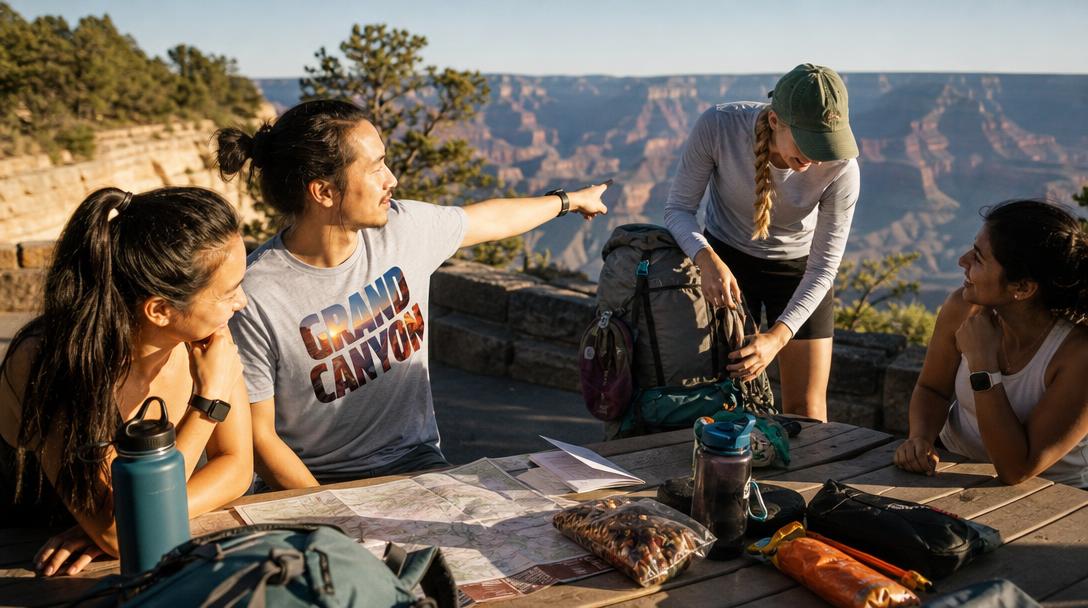
Grand Canyon backpacking below the rim requires a backcountry permit for overnight camping outside the developed rim campgrounds. For first-timers, the easiest planning path is choosing a corridor itinerary, applying through Recreation.gov, and camping at designated sites like Havasupai Gardens, Bright Angel Campground, or Cottonwood.
The big mental shift: below-rim camping is not the same as reserving regular Grand Canyon campgrounds on the rim. Mather, Desert View, and North Rim Campground are developed frontcountry campgrounds. They are great for car camping, but they are not your sleeping plan once you hike into the canyon.
For overnight trips below the rim, you are dealing with:
- Backcountry permits for designated campgrounds and use areas
- Strict itinerary dates tied to specific campsites
- Limited capacity, especially in spring and fall
- Water uncertainty, because pipeline breaks, freezes, maintenance, and storm damage can change availability
- No campfires below the rim, according to Grand Canyon National Park backcountry regulations
That last one surprises people. You can bring a stove where allowed, but you are not building a cozy little cowboy fire beside your tent. The canyon is dramatic enough without you adding smoke effects. If you are still learning the park layout, pair this guide with our Grand Canyon hiking guide for first-timers before you choose a route.
How Do Grand Canyon Permits Work for Below-Rim Camping?
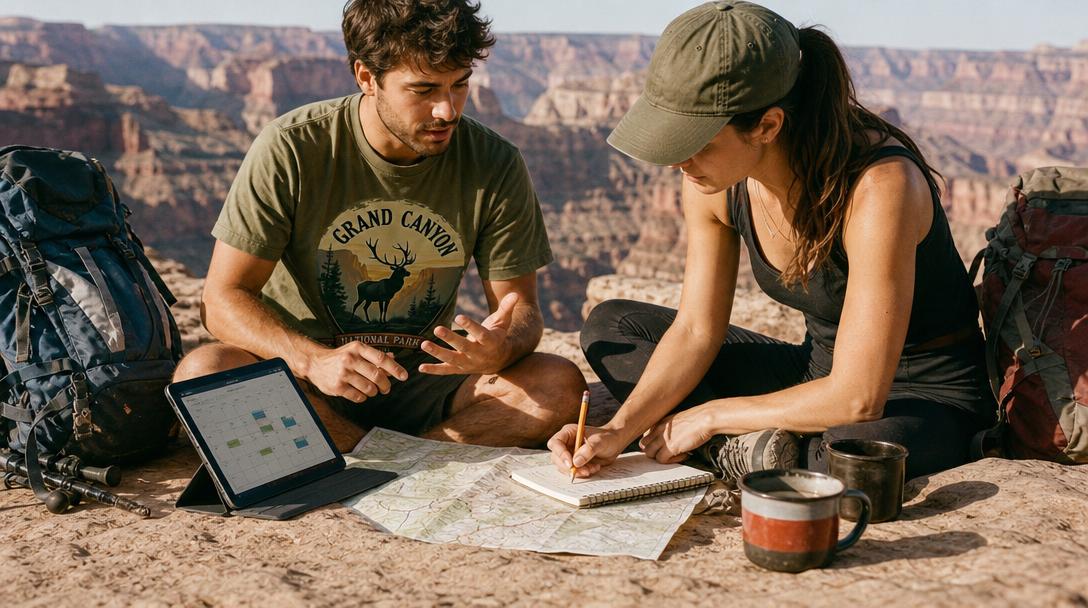
Grand Canyon permits for below-rim camping are secured mainly through the Recreation.gov early access lottery. Applicants enter four months before their trip month, winners receive a booking time slot, and remaining availability may open later. Walk-up options can exist, but popular corridor camps often fill quickly.
According to the National Park Service and Recreation.gov, a backcountry permit is required for overnight camping below the rim in places like Havasupai Gardens, Bright Angel Campground, and Cottonwood Campground. The current system is built around an early access lottery, not a simple reserve-anytime setup.
Here is the basic timeline:
-
Enter the early access lottery
- Lottery applications usually open on the 16th of the month and close on the 1st of the following month.
- This is for trips beginning four months later.
- Example: For an April trip, you would typically apply between mid-November and December 1.
-
Wait for the drawing
- The drawing is usually held on the 2nd.
- Up to 750 applicants may receive early access time slots, according to NPS permit information.
-
Book during your assigned time
- If selected, log in during your assigned booking window.
- Choose from available itineraries and campsites.
-
Pay permit and nightly fees
- Recreation.gov lists an application/permit fee and a per-person nightly fee for below-rim use.
- Recent NPS/Recreation.gov information lists a $10 application/permit fee and $15 per participant per night, but always confirm current fees before applying.
-
Check remaining availability
- If you miss the lottery, remaining availability may appear later.
- Walk-up or same-day options may be handled through the Backcountry Information Center, but treat this as a backup plan, not Plan A for a dream spring weekend.
How to Get a Grand Canyon Backcountry Permit Without Losing Your Mind
If you are wondering how to get a Grand Canyon backcountry permit, start by building multiple acceptable itineraries before lottery day. The people who struggle most are usually the ones who only want one exact campsite on one exact night during the prettiest week of October.
Before applying, prepare:
- Your preferred trip month
- Your group size
- Your first-choice itinerary
- Two or three backup itineraries
- Flexibility on weekdays
- A Recreation.gov account
- A realistic understanding of your hiking ability
Beginner-friendly permit strategy:
- Make Havasupai Gardens your first-night goal if you want the gentlest introduction.
- Consider Bright Angel Campground only if your group can handle a long descent to the river.
- Save Cottonwood for a rim-to-rim plan or North Rim-based itinerary.
- Avoid extreme heat months unless you are experienced with desert backpacking.
- Check NPS trail closures, water updates, and weather right before committing.
The permit is not just red tape. It controls crowding, protects fragile canyon resources, and helps rangers know who is sleeping where. It is less bureaucratic boulder in your path and more please do not make search and rescue guess which ravine contains your dehydrated group chat.
Best Campground for First Night in Grand Canyon Backpacking
The best campground for first night in Grand Canyon backpacking is usually Havasupai Gardens for beginners. It sits 4.5 miles below the South Rim on Bright Angel Trail, has year-round water listed by NPS, and avoids forcing new backpackers to descend all the way to the Colorado River on day one.
Havasupai Gardens, formerly known as Indian Garden, is the wise first pancake of below-rim camping. It gives you a real canyon overnight without demanding a rim-to-river day right out of the gate.
Havasupai Gardens Campground: Best Beginner First Night
NPS trail distance information lists Havasupai Gardens at about 4.5 miles from the Bright Angel Trailhead and roughly 3,800 feet elevation. The Bright Angel Trail drops steeply from the South Rim, but this campground sits before the final push to the river.
Why it works well for first-timers:
- Shorter first day than Bright Angel Campground
- Access via the well-traveled Bright Angel Trail
- Shade and water are typically more reliable than many backcountry sites
- Good place to assess how your group handles canyon hiking
- Easier emergency exit than river-level camping
A realistic beginner pace might be 3 to 5 hours down, depending on pack weight, temperature, breaks, and how many times someone stops for a casually heroic canyon photo.
Bright Angel Campground: Iconic, But Not Easy
Bright Angel Campground is near Phantom Ranch at the bottom of the canyon, close to the Colorado River. NPS distance information lists it at about 9.5 miles from the Bright Angel Trailhead via Bright Angel Trail.
This is the classic bottom-of-the-Grand-Canyon experience. It is also a serious first day.
Bright Angel Campground may fit if:
- You already backpack regularly
- Your group is comfortable hiking 9 to 10 miles downhill with overnight packs
- You start early
- Temperatures are moderate
- Everyone understands the climb out will be harder
For many first-timers, descending to Bright Angel Campground on day one makes more sense if you are taking South Kaibab Trail down and Bright Angel Trail up over two or three days. Even then, South Kaibab has no water along the trail, so planning is not optional.
Cottonwood Campground: Great for Rim-to-Rim, Not the Usual South Rim First Night
Cottonwood Campground sits along the North Kaibab Trail and is most useful for rim-to-rim routes. It can be a smart stop between the North Rim and Phantom Ranch, but it is usually not the best first-night target for a beginner starting from the South Rim.
Consider Cottonwood if:
- You have a rim-to-rim permit
- You are starting from the North Rim
- You want to break up the North Kaibab descent or climb
- You have checked current water and trail conditions
Cottonwood is wonderful in the right itinerary. It is not the place to casually add because someone in your group saw a pretty map and said it does not look that far. For more North Rim route context, see our Grand Canyon North Rim hikes guide.
Where to Camp Below the Rim in Grand Canyon Besides Tent Sites
Below the rim, backpackers can stay at designated backcountry campgrounds with a permit or at Phantom Ranch with a separate lodging reservation. Phantom Ranch is the only lodging below the canyon rim, but reservations are extremely competitive and handled separately from backcountry camping permits.
Phantom Ranch is not a campground. It is historic below-rim lodging near Bright Angel Campground, reached by foot, mule, or river trip. According to the National Park Service, advance reservations for Phantom Ranch lodging and meals are required and are handled through Grand Canyon National Park Lodges/Xanterra using a lottery system far in advance.
Important Phantom Ranch planning notes:
- It uses a separate lottery/reservation process
- It is not secured through the standard backcountry campsite lottery
- Cabins and dorm space are limited
- Meals must be reserved in advance
- Operational changes can happen, so verify current status before building your trip around it
If you win Phantom Ranch lodging, congratulations: the canyon spirits have smiled upon you. If not, Bright Angel Campground next door is the camping-based alternative, assuming you can secure the backcountry permit.
A Realistic Grand Canyon Backpacking Itinerary With Permits
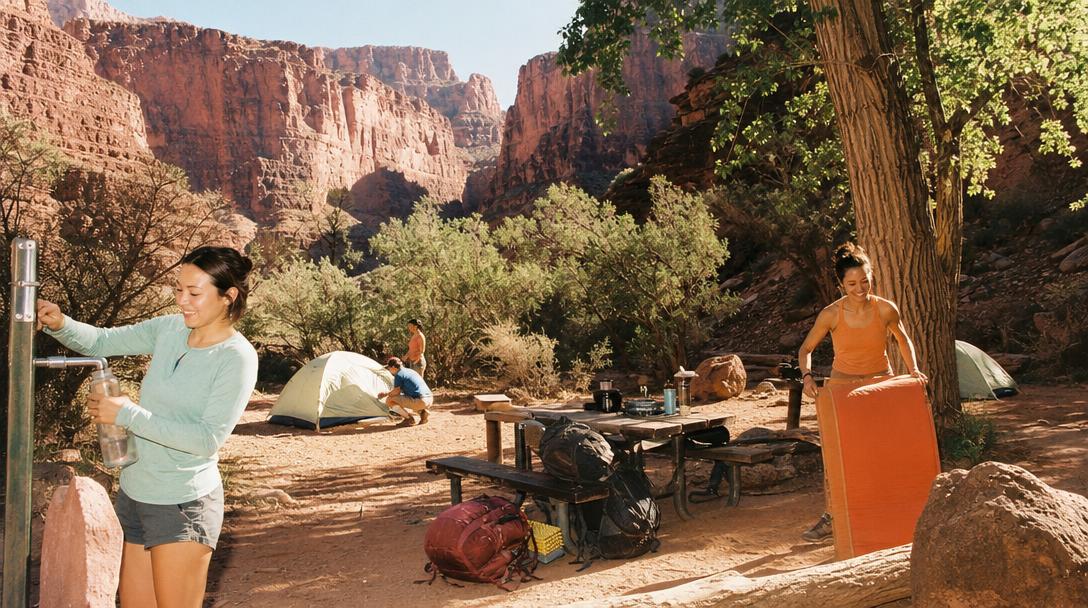
A good Grand Canyon backpacking itinerary with permits should match your experience level, season, and exit route. Beginners should prioritize shorter first days and avoid hiking uphill during peak heat, while stronger hikers can consider a river-level night at Bright Angel Campground or a 2- to 3-day corridor route.
Here are three practical options focused only on overnight stays inside the canyon.
Option 1: Beginner 1-Night Below-Rim Camping Trip
Permit target: Havasupai Gardens
Route: Bright Angel Trail out and back
Best for: First-time Grand Canyon backpackers
Day 1:
- Start at Bright Angel Trailhead
- Hike 4.5 miles down to Havasupai Gardens
- Set up camp
- Rest, hydrate, eat early
- Optional short exploring only if weather and energy allow
Day 2:
- Start before sunrise or early morning
- Hike 4.5 miles back to South Rim
- Take breaks at resthouses
- Celebrate with snacks and that thousand-yard canyon stare
This is the best first-night itinerary if you want a below-rim experience but also enjoy having knees.
Option 2: Classic 2-Night Corridor Backpacking Trip
Permit target: Night 1 Havasupai Gardens, Night 2 Bright Angel Campground
Route: Bright Angel Trail to Havasupai Gardens, then to river/Bright Angel Campground, then climb out
Best for: Fit beginners with backpacking experience or cautious intermediates
Day 1:
- South Rim to Havasupai Gardens
- 4.5 miles downhill
- Settle in and acclimate to canyon conditions
Day 2:
- Havasupai Gardens to Bright Angel Campground
- Continue to river level
- Camp near Phantom Ranch/Bright Angel Creek area
Day 3:
- Start very early
- Climb out via Bright Angel Trail
- Expect this to be the hardest day
This itinerary gives you a staged descent, one night partway down, and one night at the bottom. It is far more forgiving than dropping all the way to the river on day one.
Option 3: 2-Night Rim-to-Rim Style Plan
Permit target: Cottonwood and Bright Angel Campground, or Bright Angel Campground and Havasupai Gardens depending on direction
Route: North Kaibab + Bright Angel corridor
Best for: Experienced hikers with logistics dialed
A rim-to-rim plan is not just a longer walk. It involves shuttle logistics, seasonal North Rim access, bigger elevation changes, and more exposure to changing conditions.
A common structure:
- Night 1: Cottonwood Campground
- Night 2: Bright Angel Campground
- Exit: South Rim via Bright Angel Trail
Or reverse it depending on direction, permit availability, and season. For first-time backpackers, this is better as a future goal than a first below-rim overnight.
Why Is 90% of the Grand Canyon Restricted?
There is no simple public rule stating that 90% of the Grand Canyon is restricted for backpackers. What is true is that most below-rim overnight use is managed through permits, designated campgrounds, use areas, group limits, and seasonal closures to protect fragile desert ecosystems, cultural sites, water sources, and visitor safety.
People often hear restricted and imagine velvet ropes around the canyon. The reality is more nuanced.
Grand Canyon National Park manages backcountry travel because:
- Desert soils and biological crusts are easily damaged
- Water sources are rare and sensitive
- Cultural and archaeological sites need protection
- Rescue access can be difficult or dangerous
- Popular areas would be overrun without limits
- Some zones require advanced navigation and self-sufficiency
For your first trip, this actually helps. Instead of staring at a massive map wondering where to legally sleep, you can focus on the corridor campgrounds and build a safe permit itinerary.
What Is the 200 Rule for Camping?
The 200 rule usually refers to the Leave No Trace guideline of camping at least 200 feet from water sources, trails, and fragile areas when dispersed camping is allowed. In Grand Canyon corridor backpacking, your permit and assigned campground matter more: camp only where your backcountry permit allows.
This is an important distinction. General outdoor advice is useful, but it does not override park-specific rules. Our Leave No Trace guide for America’s wilderness is a helpful refresher before any backcountry trip.
Below the rim in the main corridor:
- Camp in your assigned campground or permitted use area
- Do not create new campsites
- Follow food storage rules
- Pack out trash
- Do not wash dishes directly in creeks
- Do not build fires
At designated campgrounds, you are not wandering 200 feet away to invent a better campsite. You are using the assigned camping area so the impact stays concentrated and manageable.
Are There Grizzly Bears in the Grand Canyon?
There are no grizzly bears in Grand Canyon National Park. The park’s wildlife concerns are different: ravens, squirrels, ringtails, mice, and other animals can raid food, damage gear, and become aggressive when people feed or attract them, so proper food storage still matters.
This is good news if you were picturing a grizzly sniffing your ramen at Bright Angel Campground. Bad news: the smaller critters are extremely talented little chaos goblins.
Food storage basics:
- Use provided food storage boxes or poles where available
- Never leave snacks in your tent
- Keep scented items secured
- Do not feed wildlife
- Pack out micro-trash like wrappers and food bits
A squirrel with a taste for trail mix can ruin your morning faster than you would expect.
How Many People Fall From Grand Canyon Every Year?
Falls at the Grand Canyon cause roughly 2 to 3 deaths per year on average, while total annual deaths from all causes are often reported around 10 to 17 depending on the time period. Most deaths are not from falls; heat illness, medical emergencies, drowning, and other accidents also contribute.
That statistic should not scare you away from backpacking, but it should make you behave like gravity is undefeated.
For below-rim camping trips, the bigger everyday risks are often:
- Heat exhaustion
- Dehydration
- Overpacking
- Underestimating the climb out
- Hiking too late in the day
- Ignoring water updates
- Getting behind schedule
Stay back from edges, yes, but also start early, drink electrolytes, eat enough, and do not let your group’s fastest hiker set the pace for everyone.
First-Night Below-Rim Gear Checklist
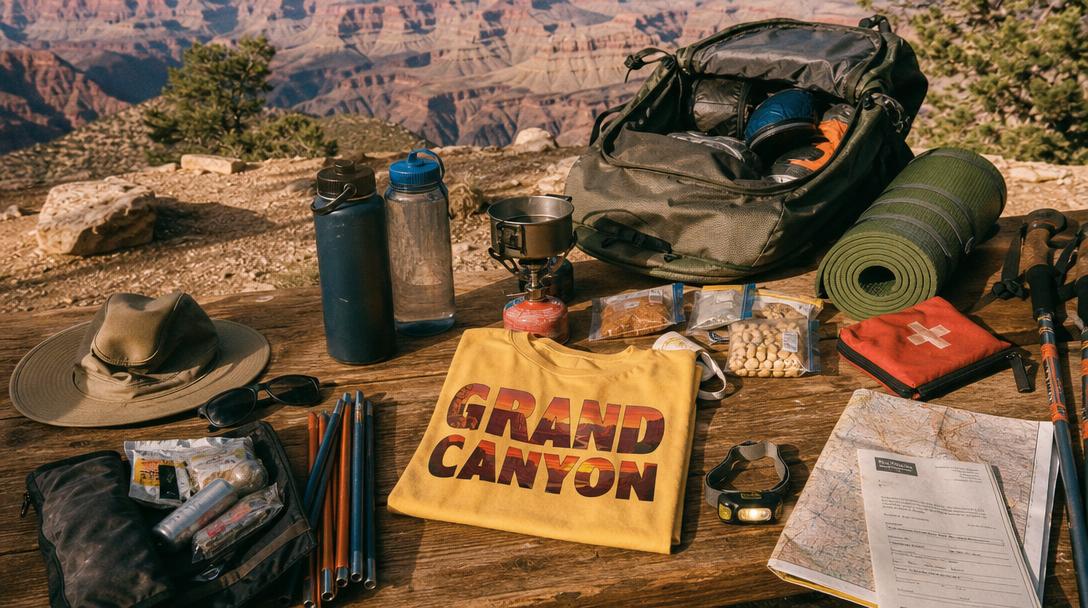
Packing for below-rim camping is a balancing act. Too little gear and you are uncomfortable. Too much gear and the canyon turns you into a slow-moving souvenir.
Bring:
- Backcountry permit and ID
- Printed itinerary
- Tent or shelter
- Sleeping bag or quilt appropriate for season
- Sleeping pad
- Stove and fuel
- Water bottles/bladder with enough capacity
- Water treatment backup
- Electrolytes
- Sun hat and sunglasses
- Headlamp
- First aid kit
- Map or downloaded offline navigation
- Layers for temperature swings
- Food storage plan
- Wag bags or waste supplies if required for your route/use area
- Trekking poles
- Broken-in hiking shoes
For packing strategy, our how to pack a hiking backpack guide can help you keep weight balanced before the canyon starts negotiating with your shoulders.
Casual Graphic Tees for the Rim, Camp Lounging and Post-Hike Photos
For clothing while actively hiking, prioritize function: breathable layers, sun protection, and moisture management. Save cotton and casual graphic tees for the rim, camp lounging in safe conditions, travel days, or the post-hike photo where you pretend you did not just bargain with your calves for six hours.
If you want a souvenir-style layer with canyon personality, Hike Tee’s Grand Canyon Red Sunset Shirt and vintage Grand Canyon Shirt fit that I survived, but make it goofy energy. The Grand Canyon National Park Shirt is another easy casual option for road trips, lodge days, and rim viewpoints.
Frequently Asked Questions
Do you need a permit for below-rim camping in Grand Canyon?
Yes. A backcountry permit is required for overnight camping below the rim outside developed rim campgrounds. This includes popular corridor sites like Havasupai Gardens, Bright Angel Campground, and Cottonwood Campground.
What is the best campground for first night in Grand Canyon backpacking?
Havasupai Gardens is usually the best campground for first night in Grand Canyon backpacking because it is 4.5 miles down Bright Angel Trail and avoids a full rim-to-river descent. It gives beginners a real below-rim camping experience with a more manageable first day.
How do you get a Grand Canyon backcountry permit?
To get a Grand Canyon backcountry permit, apply through the Recreation.gov early access lottery about four months before your trip month. Have backup itineraries ready, because popular corridor campgrounds fill quickly, especially in spring and fall.
Where should beginners camp below the rim in Grand Canyon?
Most beginners should look first at Havasupai Gardens because it is closer to the South Rim than Bright Angel Campground and does not require a full descent to the Colorado River on day one.
Why is 90% of the Grand Canyon restricted?
The phrase is misleading. Most of the Grand Canyon is not casually open for unrestricted camping because overnight use is managed by permits, designated sites, use areas, and closures that protect fragile resources and improve safety.
What is the 200 rule for camping?
The 200 rule is a general Leave No Trace guideline recommending that campers stay 200 feet from water, trails, and sensitive areas when dispersed camping is allowed. For Grand Canyon below-rim camping, follow your permit and camp only in your assigned campground or use area.
Are there grizzly bears in the Grand Canyon?
No, there are no grizzly bears in the Grand Canyon. Still, proper food storage is essential because ravens, squirrels, mice, and other animals can steal food or damage gear.
How many people fall from Grand Canyon every year?
Reports commonly estimate about 2 to 3 fatal falls per year on average, while total annual deaths from all causes are higher. Falls get headlines, but heat illness, medical issues, drowning, and other emergencies are also major risks.
Your First Grand Canyon Backpacking Night Should Feel Big, Not Reckless
The smartest first Grand Canyon overnight is the one that matches your actual fitness, season, permit, and group, not the one that looks most impressive in a trip report.
Key takeaways:
- Use the Grand Canyon permits system early, especially for spring and fall.
- Choose Havasupai Gardens for the most beginner-friendly first night.
- Pick Bright Angel Campground if you are ready for a longer descent to the river.
- Use Cottonwood mainly for rim-to-rim or North Kaibab itineraries.
- Treat Phantom Ranch as a separate lodging lottery, not a campground.
- Verify water, closures, weather, and trail updates with NPS before your trip.
Start with a realistic 1- or 2-night below-rim itinerary, keep your pack reasonable, and give the canyon the respect it deserves. The goal is not to conquer the Grand Canyon. The goal is to wake up below the rim, sip coffee while the walls glow orange, and think: worth every switchback.


