


Womens Graphic Tank Guide: Fit, Fabric, and Trail Tips
You're two miles into a sunny trail and the cute cotton tank that looked perfect at breakfast is now damp, clingy, and rubbing under your pack straps. Your shoulders are getting more color than you ordered, while the printed design appears to be staging a slow retreat from the fabric. Suddenly, your womens graphic tank isn't just an outfit choice. It's gear.
A good one should handle sweat, movement, sun, shoulder straps, and repeated washing without turning into a sad little rag. The trade-offs are real. Cotton feels soft on the porch but can become heavy when wet, while polyester, merino, and nylon blends can stay lighter, dry faster, and hold their shape better. A sleeveless cut also brings more airflow, but it leaves more skin exposed.
The right pick depends on your trail, your layering plan, your body, and how much you want the graphic to survive laundry day. Below, we'll sort through fabric labels, necklines, fit, UPF ratings, cool-morning layers, trail-to-town styling, and print care, so you can shop a product page with confidence instead of regret.
Table of Contents
- Why Your Graphic Tank Matters More Than You Think
- Performance Fabrics That Actually Work in a Tank
- Neckline and Fit Options Worth Knowing
- Sun Protection Without the Sunburn Surprise
- Layering a Graphic Tank From Cool Morning to Hot Summit
- Sizing Guidance That Stops the Guesswork
- Trail-to-Town Styling That Still Looks Intentional
- Print Care and a Final Buyer Checklist
Why Your Graphic Tank Matters More Than You Think
A womens graphic tank earns its place in a hiking wardrobe when it does more than look good in a trailhead photo. It needs to move with your shoulders, stay tolerable beneath a pack, and dry before sweat starts feeling like a second shirt. That matters especially on warm day hikes, where a sleeveless silhouette can feel wonderfully breezy until the sun lands directly on your shoulders.
The market is large enough to support that kind of specialization. A market report values global graphic apparel at $42.3 billion in 2025, with women's graphic apparel representing 35.4% and T-shirts representing 32.5%, or $13.7 billion in revenue. The same report points to expanding design options for female consumers, which helps explain why women's silhouettes remain commercially important in print-forward casualwear. MarketIntelo's graphic apparel market overview provides that broader category context.
Trail-tested rule: Treat the graphic as the bonus. Fabric, fit, and sun strategy decide whether the tank deserves another hike.
Softness versus staying comfortable
A cotton tank can feel excellent during a slow morning, especially if you're driving to a park, walking a visitor center, or lounging at camp. On a sustained climb, though, cotton absorbs perspiration and holds it close to the body. That wet fabric can cling at the bust, rub beneath a hip belt or shoulder strap, and cool you unpleasantly when the breeze arrives.
A polyester blend usually feels less plush in the hand, but it can move moisture toward the fabric surface so it evaporates faster. A merino blend adds a different advantage, odor management, though it may cost more and need gentler care. Nylon-spandex blends are particularly useful when you're reaching, scrambling, or carrying trekking poles because they stretch without feeling restrictive.
The sleeveless trade-off
Sleeveless tops improve airflow around the underarms and can feel less bulky beneath an open layer. They also expose the deltoids and upper arms, areas that may take the full force of midday sun. A graphic tank can work beautifully on a shaded forest walk, but an exposed ridge calls for more than optimism and a cute print.
Good shopping means asking a slightly unglamorous question: Where will this tank fail first? Look at the armhole edge, shoulder seam, neckline, and print boundaries. Those spots experience stretching, rubbing, and repeated laundering. A tank that survives the fitting room but chafes under your pack by the third mile isn't a bargain.
Performance Fabrics That Actually Work in a Tank
Start with the fiber content, then translate the marketing language into behavior. Hold the tank in your hands and ask how it will respond after an hour of uphill effort, not how it feels under bright store lighting.
Polyester blends are the most common practical choice for an active graphic tank. Moisture-wicking construction moves sweat away from your skin toward the outer surface, where it can evaporate. Quick-dry finishes help the fabric recover faster after exertion. Polyester also gives printers a stable surface for crisp graphics, although print durability still depends on the decoration process and laundering.
Merino wool feels softer and warmer than many people expect. Lightweight merino can help manage odor during travel or consecutive wear, but it may be more delicate and can cost more. Nylon-spandex blends offer stretch and recovery, making them useful for high-movement hikes, travel walking, and active layering.
GSM, or grams per square meter, is the fabric's thickness dial. A lighter knit generally feels cooler and packs smaller, while a heavier one may offer more coverage and durability. For summer hiking, 120 to 160 GSM is a useful target range to investigate, but the number only helps when paired with the actual knit, fiber, and fit.
Decode the label
- Moisture-wicking: Sweat moves away from the skin rather than sitting in one saturated patch.
- Quick-dry: The fabric is designed to release moisture efficiently, though drying still depends on humidity, airflow, and how soaked the garment becomes.
- Dri-Release: A blend or finish intended to combine moisture movement with faster drying. Check the fiber content rather than assuming the name tells you everything.
- Four-way stretch: The fabric stretches across and along the body, helpful when reaching overhead or navigating uneven ground.
- UPF-rated: The garment has a stated ultraviolet protection rating. Don't assume every dark or tightly woven tank carries one.
Cotton and rayon can still make sense for low-output wear, but they're less forgiving on sweaty trails. If a listing says 100% cotton and your hike lasts over an hour, expect a damp, heavier tank once the switchbacks start.
| Fabric | Weight/Feel | Wicking & Dry Time | Odor Control | Best For |
|---|---|---|---|---|
| Polyester blend | Light, smooth, sometimes technical | Strong moisture movement and quick drying | Moderate, depends on treatment | Hot hikes and everyday active wear |
| Lightweight merino | Soft, warm to the touch | Good moisture buffering, moderate drying | Strong natural odor management | Travel, variable weather, repeated wear |
| Nylon-spandex | Smooth, stretchy, close-fitting | Good drying with a technical feel | Moderate | High movement and athletic layering |
| Cotton | Soft, familiar, absorbent | Slow once saturated | Limited when damp | Casual wear and easy walks |
| Rayon blend | Drapey and soft | Can stay wet and lose structure | Limited | Town styling and low-output use |
For a plain-language explanation of the mechanism, HikeTee's guide to what moisture-wicking fabric means is a useful companion while you compare listings. If a product page only says “performance feel” without naming moisture management, quick drying, fiber content, or UPF, treat that omission as information.
Neckline and Fit Options Worth Knowing
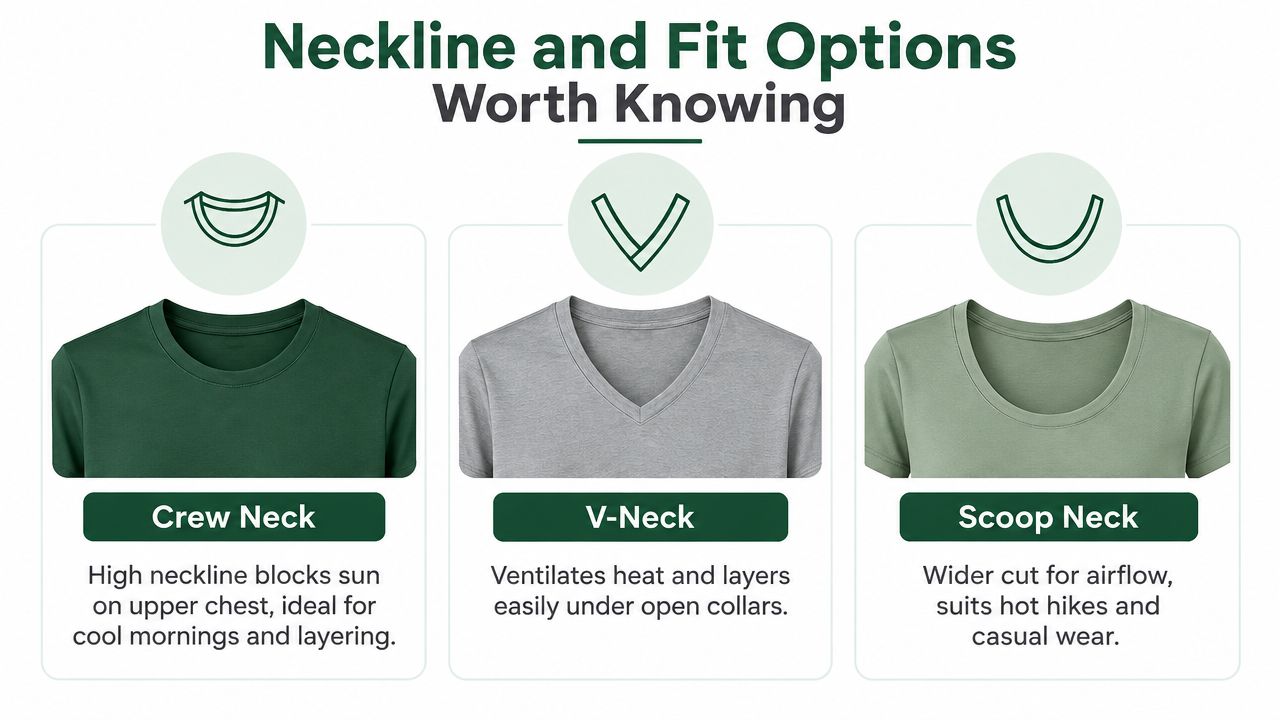
The best neckline depends on where the sun hits, how your pack sits, and what you plan to wear over or under the tank. A crew neck gives the most upper-chest coverage and usually feels secure beneath a fleece. A V-neck vents heat and layers neatly under an open flannel or button-down. A scoop neck feels breezier, but it exposes more of the upper chest and may show more sports-bra structure.
Racerbacks create shoulder clearance and can work well with pack straps, though the narrow rear straps may reveal bra bands or feel less comfortable under a loaded pack. A standard tank with wider shoulder coverage can distribute pressure better, especially when you're carrying food, water, and the mysterious emergency layers that never get used until the exact day you leave them behind.
Match the cut to the job
A relaxed fit leaves room for airflow and feels forgiving on hot walks. A semi-fitted cut usually balances movement with easier layering. A compression fit can work for high-output activity, but it leaves less room for sweat, body changes, and personal comfort. If you dislike fabric touching your stomach or ribs while climbing, compression probably won't become your trail soulmate.
Body proportions matter, but they don't dictate one universal answer. Shorter torsos often feel better in a slightly shorter body length, while longer torsos may need extra length to prevent the hem from riding up beneath a hip belt. Broader shoulders can benefit from a wider neck opening that doesn't pinch. A larger bust often works better with a deeper V or scoop and a longer body that stays put.
Pack-strap test: Put the tank on, add your sports bra, and place your pack straps where they actually sit. If a neckline or shoulder seam lands directly beneath the pressure point, expect rubbing by mile three.
Try reaching overhead, twisting, and lifting your arms as if you're grabbing a trekking pole from a side pocket. The armhole should allow movement without cutting into the underarm. The hem should stay reasonably stable without requiring constant tugging. A graphic tank that passes those tests will feel much more useful than one that only photographs well.
Sun Protection Without the Sunburn Surprise
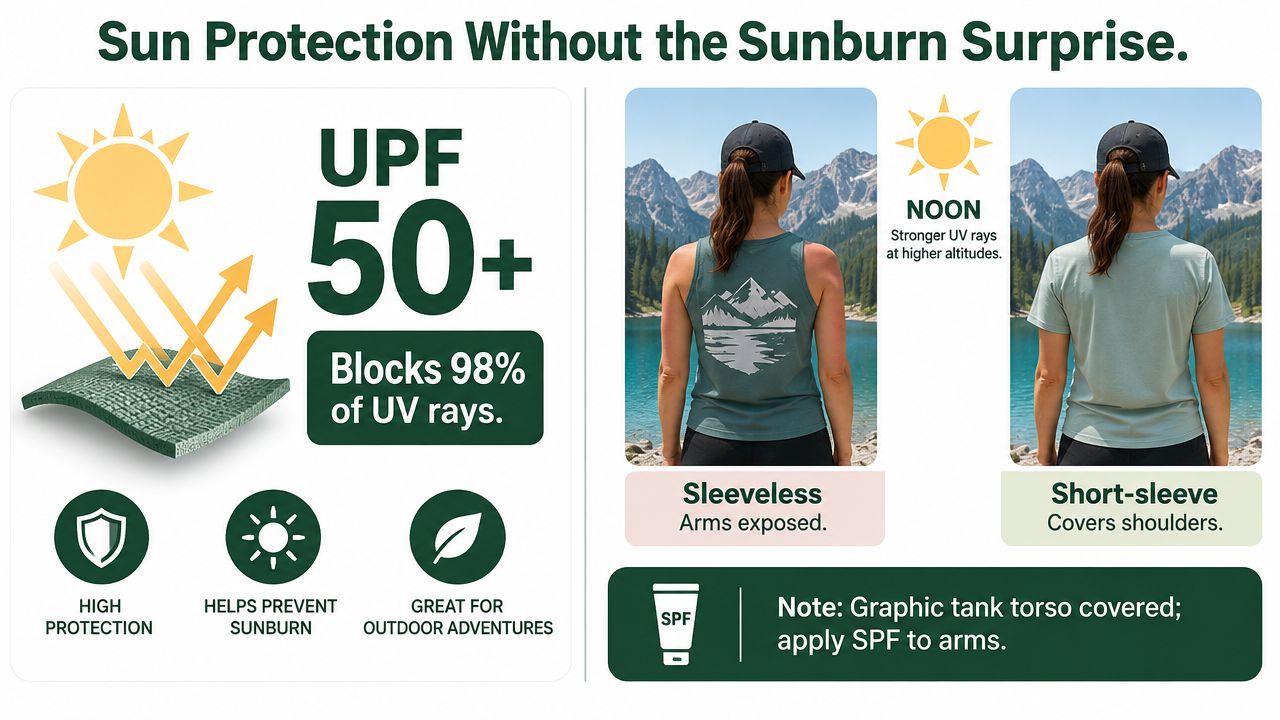
UPF 50+ sounds like technical alphabet soup until you see the math. A UPF 50+ fabric blocks 98% of UV radiation, allowing 2%, or 1/50, through according to MontForge's UPF 50+ explanation. That protection applies to the covered fabric, not automatically to your exposed arms, shoulders, neck, or upper chest.
A sleeveless tank changes the exposure equation. Your torso may be covered, but your deltoids and upper arms receive direct sun, and a pack strap can trap heat across one shoulder while leaving the other exposed. At an alpine lake around midday, reflected light can make that arrangement feel harsher than the temperature suggests.
Build coverage around the tank
A UPF rating is valuable, but it doesn't turn a tank into a full sun system. Apply sunscreen to the exposed skin you can't cover, including shoulders, upper arms, and the back of your neck. For readers managing reactive or easily irritated skin, this practical guide to sun protection for sensitive skin offers a helpful starting point for choosing and applying protection.
Pair the tank with deliberate accessories:
- A brimmed hat: A wider brim helps shade the face and upper neck more effectively than a tiny cap.
- Sun sleeves: Lightweight sleeves let you keep the tank's airflow while covering the arms on a ridge walk.
- A neck flap or buff: Useful when the trail turns exposed and the back of your neck starts feeling like toast.
- Mineral sunscreen: Apply it before the hike and reapply according to the product directions, especially after heavy sweating.
Dark graphics may absorb more heat than pale ones, particularly across a large printed panel. That doesn't make dark prints unusable, but it can matter on exposed climbs. For additional detail on ratings and garment coverage, HikeTee's guide to UPF-rated hiking shirts is worth bookmarking.
Fair-skinned hikers, high-elevation walkers, and anyone crossing reflective water should plan coverage before leaving the trailhead. Airflow is a comfort feature, not a sun-protection strategy. Let the tank breathe, but give your shoulders and arms backup.
Layering a Graphic Tank From Cool Morning to Hot Summit
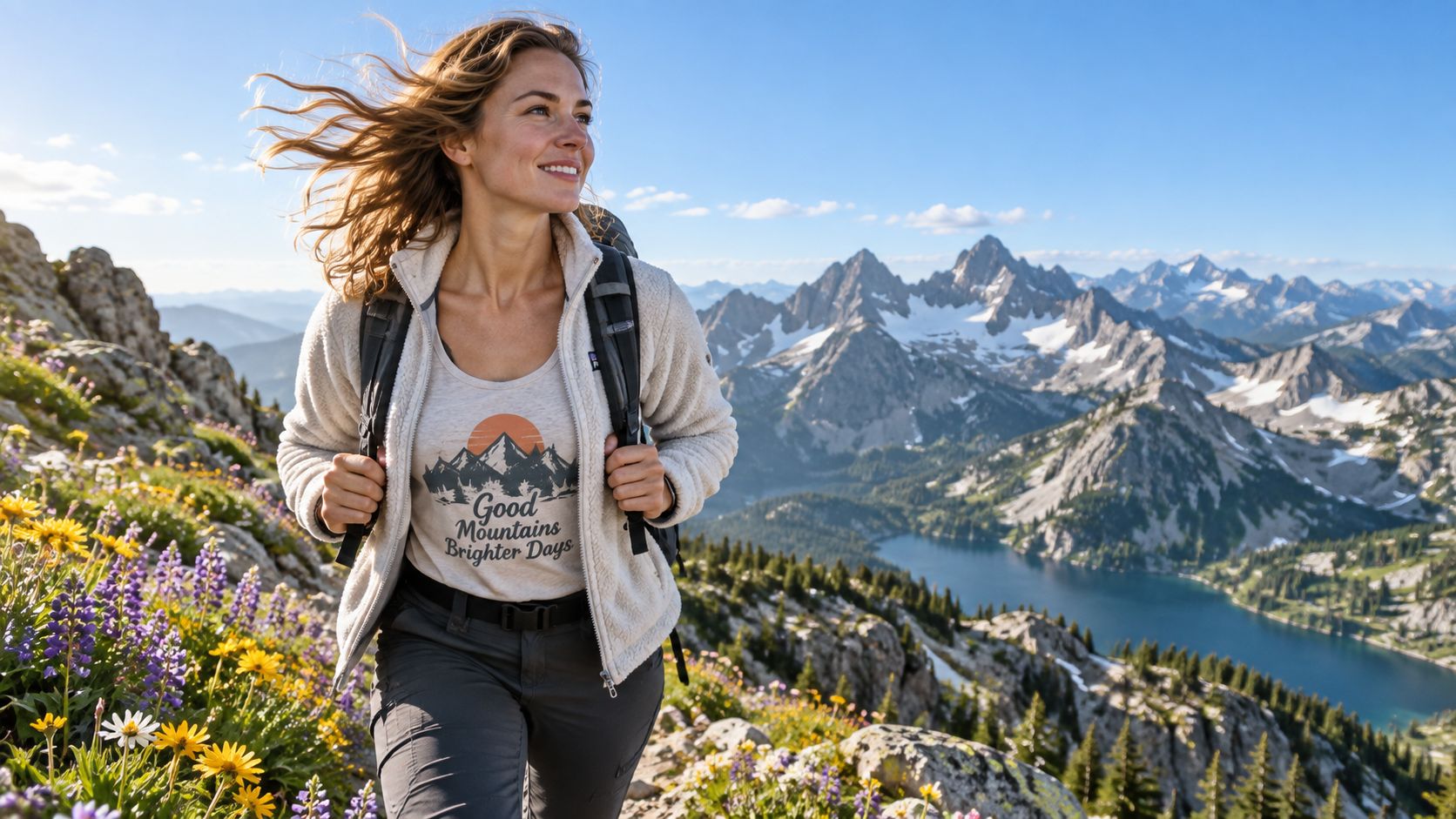
A graphic tank can anchor a surprisingly flexible system if the layers above it don't fight the fabric. On a cool trailhead morning around 45°F, start with the tank under a packable puffy. The puffy supplies warmth without adding much bulk, and you can stuff it into your pack once your body temperature rises.
At a windy ridge, swap the puffy for a light fleece or wear the fleece over the tank if you need continuous insulation. Choose a smooth graphic surface and a fleece that slides over it without catching the print. A sleeveless base also leaves your arms less restricted beneath a zip-front midlayer, which is handy when the trail demands scrambling or frequent pole adjustments.
Make the layers cooperate
Wide tank straps help reduce bra show-through and can distribute pressure beneath pack straps. If your sports bra has thick shoulder bands, check that the tank's straps don't land directly on top of them. That overlap can create a small, persistent pressure ridge that becomes much more annoying than it sounds.
Avoid pairing a damp cotton midlayer over a synthetic tank if you're trying to dry out. The cotton can hold moisture against the system and slow evaporation. For shoulder-season rain, add a lightweight shell rather than relying on a fleece alone. A shell also blocks wind on exposed ridges, where a sleeveless base can otherwise feel chilly once you stop moving.
The summit test is simple: If you can shed the outer layer and still feel comfortable at the lunch stop, your system works. If the tank feels clammy, the midlayer is too warm, or the shell has nowhere to go, adjust before the next outing rather than blaming the mountain.
Sizing Guidance That Stops the Guesswork
A size chart only helps when you know what its measurements mean on your body. Bust measurement tells you whether the fabric will pull across the fullest point. Hem width hints at whether the tank will skim or cling around your waist and hips. Body length determines whether it stays tucked, covers the waistband, or rides up beneath a hip belt.
Measure a favorite tank at home and compare it with the product page. Lay it flat, measure across the bust and hem, then check the body length from the highest shoulder point to the bottom edge. This method beats guessing from a familiar letter size because brands cut tanks differently. Mall labels may offer a roomier interpretation of a size, while outdoor brands often use slimmer athletic cuts.
Practical rule: Never trust a chart you haven't compared with a garment you already like wearing.
Where shoppers commonly split sizes
Broad shoulders with a smaller bust can make the neckline and armholes feel restrictive even when the bust measurement looks correct. A longer torso may need extra length, while a postpartum body may prefer more room through the midsection without wanting a larger neckline. Those are fit decisions, not failures to match a “standard” shape.
| Measurement | Size Up If | Stay True If |
|---|---|---|
| Bust | The fabric pulls, the armhole cuts in, or you'll wear a sports bra underneath | The chest lies smoothly without flattening or gaping |
| Hem | You want airflow, dislike cling, or carry layers at the waist | You prefer a cleaner tucked or streetwear silhouette |
| Body length | The hem rides above your waistband or pack belt | The tank stays in place during overhead movement |
| Shoulder width | Straps dig in or sit too close to the neck | The straps remain flat without sliding outward |
| Armhole | Movement feels limited or the edge rubs | You can reach, twist, and carry a pack comfortably |
For trail performance, sizing up can create useful airflow and layering room. For a cleaner town look, staying true to size may give the graphic a sharper shape. Don't size down to make a tank look fitted if the armholes or bust become restrictive. A fitted tank should still let you breathe, reach, and carry your day.
Check the return policy before ordering, especially when the listing doesn't provide garment measurements. A tank that works on a short walk but fails under a pack is not a successful fit.
Trail-to-Town Styling That Still Looks Intentional
The easiest trail-to-town outfits make one deliberate change instead of pretending you didn't just hike. Keep the graphic tank as the hero, then soften the technical details with texture, structure, or a cleaner accessory. The result should say “I had a good day outside,” not “I may have a granola bar in every pocket.”
The brewery stop
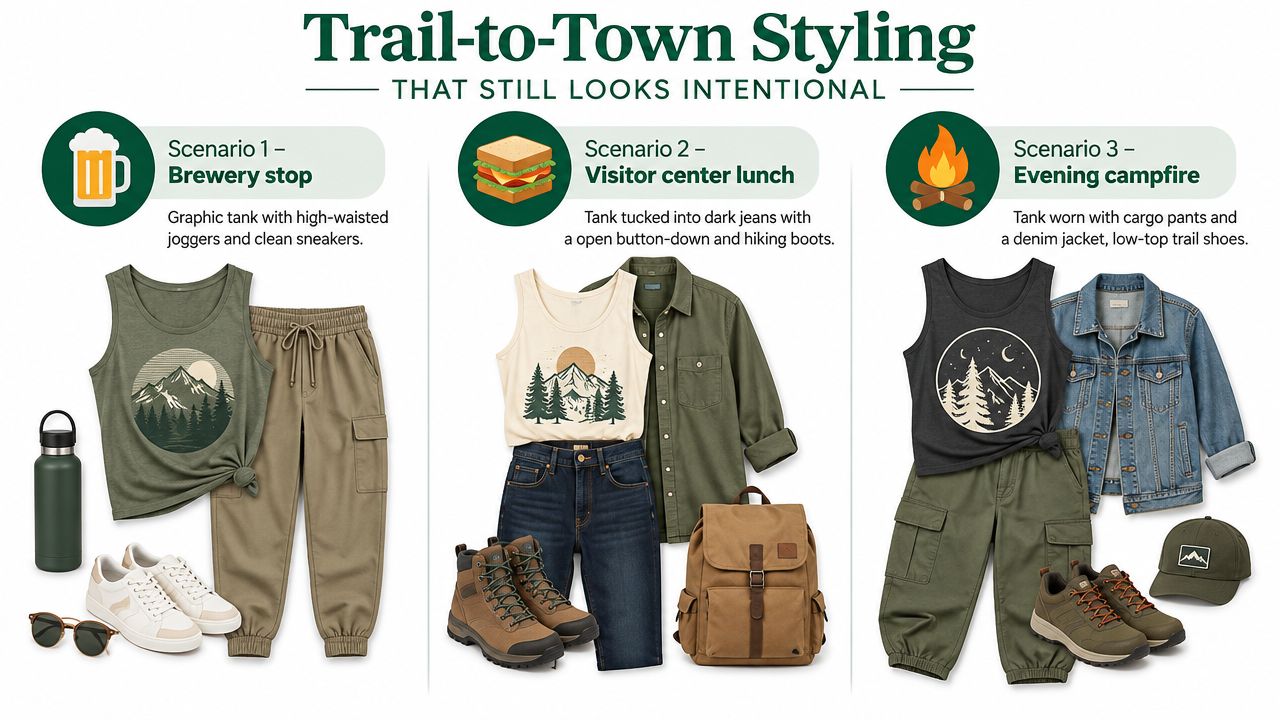
For a casual brewery, wear the tank with high-waisted joggers and clean sneakers. This works especially well when the tank has a small chest graphic or restrained park illustration. If the fabric looks very technical and shiny, add a linen overshirt or a canvas chore jacket to break up the athletic finish.
Swap the trail pack for a simple tote if your car is nearby. Pulling your hair into a low bun or ponytail also makes the outfit feel refreshed without requiring a complete change. Clean socks matter more than people admit.
The visitor center lunch
Tuck the tank into dark jeans and add an open button-down. Hiking boots can stay on if they're clean, or you can switch to low-profile leather sneakers for a more town-ready look. A faded, vintage-feel graphic transitions better here than a neon performance print or an oversized logo that dominates the entire outfit.
The open shirt gives your shoulders some coverage without hiding the tank. It also lets you manage temperature inside a crowded visitor center, where the air can feel very different from the trail.
The evening campfire
Cargo pants, a denim jacket, and low-top trail shoes make the tank useful after the day's walking is over. A larger back print can work in this setting because the denim adds structure and keeps the outfit from feeling like pure activewear. Roll the jacket sleeves, add a simple watch, and leave the tank untucked if the hem already has a relaxed shape.
Graphic choice controls the mood. Small chest hits look cleaner, busy back prints feel more playful, and subdued colors usually style more easily than high-contrast performance palettes. You don't need to hide the hiking identity. Just give it one non-hiking neighbor.
Print Care and a Final Buyer Checklist
High heat is the print's natural enemy. Whether the design uses plastisol, water-based ink, or another decoration system, repeated heat, friction, stretching, and harsh washing can encourage cracking, peeling, fading, or color bleed. Sleeveless tanks also experience extra stress around the armholes, bust, side seams, and shoulder edges.
Use a simple routine:
- Turn the tank inside out. This reduces direct abrasion against the print during washing.
- Choose a cold wash. Cooler water is gentler on dyes, fibers, and decoration.
- Skip fabric softener. It can leave residues that affect performance finishes and fabric feel.
- Hang dry away from direct sun. High dryer heat and prolonged sunlight both work against print longevity.
- Iron only from the reverse side. Never press a hot iron directly over the artwork.
- Avoid dry cleaning unless the care label specifically supports it. Solvents and heat can create problems for some prints and performance finishes.
HikeTee's guide to washing graphic tees offers additional care guidance for decorated apparel. If laundry piles up after a trip, a door-to-door laundry service can handle routine washing, but check that the service follows your garment's care label and doesn't automatically use high heat.
What to check before buying
- Fabric hand-feel: Look for a knit that feels light and flexible without seeming flimsy.
- Moisture claims: Prefer explicit moisture-wicking and quick-dry language over vague “active” wording.
- UPF rating: Choose a stated rating when the tank will see extended sun.
- Seam construction: Inspect shoulder and armhole seams for stability and smooth finishing.
- Print method: Look for care information and evidence that the decoration is intended to flex and withstand laundering.
- Colorfastness: Reviews can reveal whether a dark print or garment color fades quickly.
- Brand transparency: Fiber content, garment measurements, care instructions, and return terms should be easy to find.
- Price per wear: A tank that survives regular hikes, travel days, and casual outfits may offer more value than a cheaper piece you avoid wearing.
Test the new tank on a short local hike before taking it on a multi-day trip. Wear the sports bra and pack you'll use. Check for chafing, hem movement, print irritation, cling, and odor after the walk. The mountain can wait until your clothing has passed the neighborhood trial.
HikeTee offers women's outdoor graphic apparel built around hiking, camping, wildlife, and national park themes, with options suited to everyday wear and light outdoor activity. Browse the women's styles at HikeTee, compare the graphic and fit you want, and choose a tank that can make the trail-to-town transition without demanding a costume change.


